CHATVET · AI COPILOT FOR VETERINARY MEDICINE

Shipping an AI copilot vets say saves them about 15 minutes per case

Veterinarians are out of time. Research, protocol hunting, note-writing, and client communication stack up on every case.

The references vets trust, like the Merck Veterinary Manual, were never built to be searched with a patient on the table and a client waiting.

ChatVET is an AI copilot powered by the Merck Veterinary Manual and leading journals, built to return those answers in seconds.
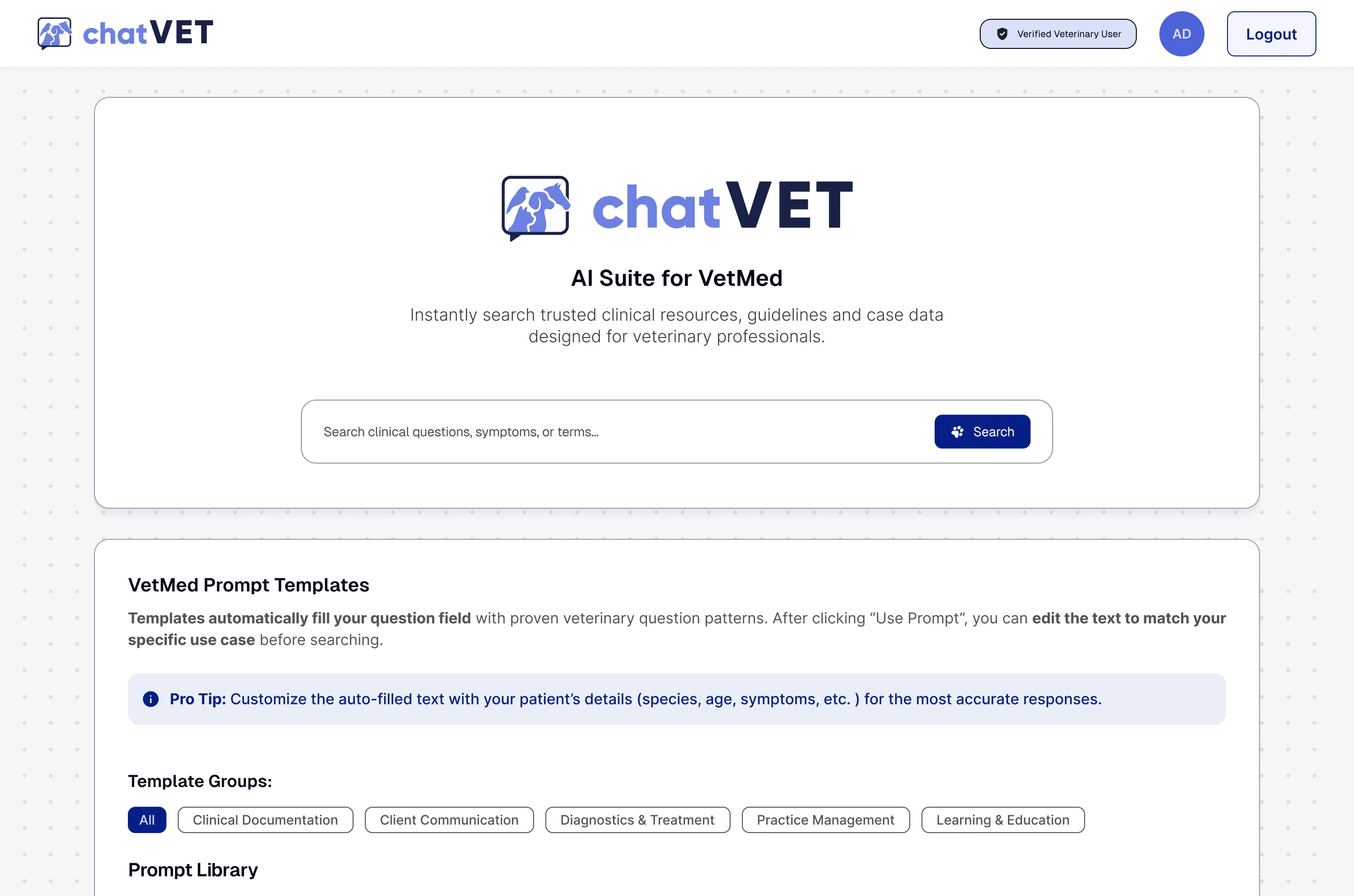
ChatVET home for a verified veterinary user: the brand card with a clinical search bar, above VetMed Prompt Templates grouped by clinical job.
ROLE:
Product Designer & UX ResearcherConsulting engagement
TEAM:
Startup foundersengineeringmeMostly part-time, ~10 hrs/week
TIMEFRAME:
Feb 2025 – Jun 2026Now consulting
STATUS:
Shipped and live500 monthly users

The biggest stall in a veterinary appointment happens after the client leaves.

I helped lead market research: interviews and case walkthroughs with five practicing DVMs and techs.

We mapped where a visit stalls and found four points: searching protocols, calculating doses, explaining the plan to the client, and re-entering the history once the room is empty.

That last one falls outside the appointment entirely, and it was the largest of the four.
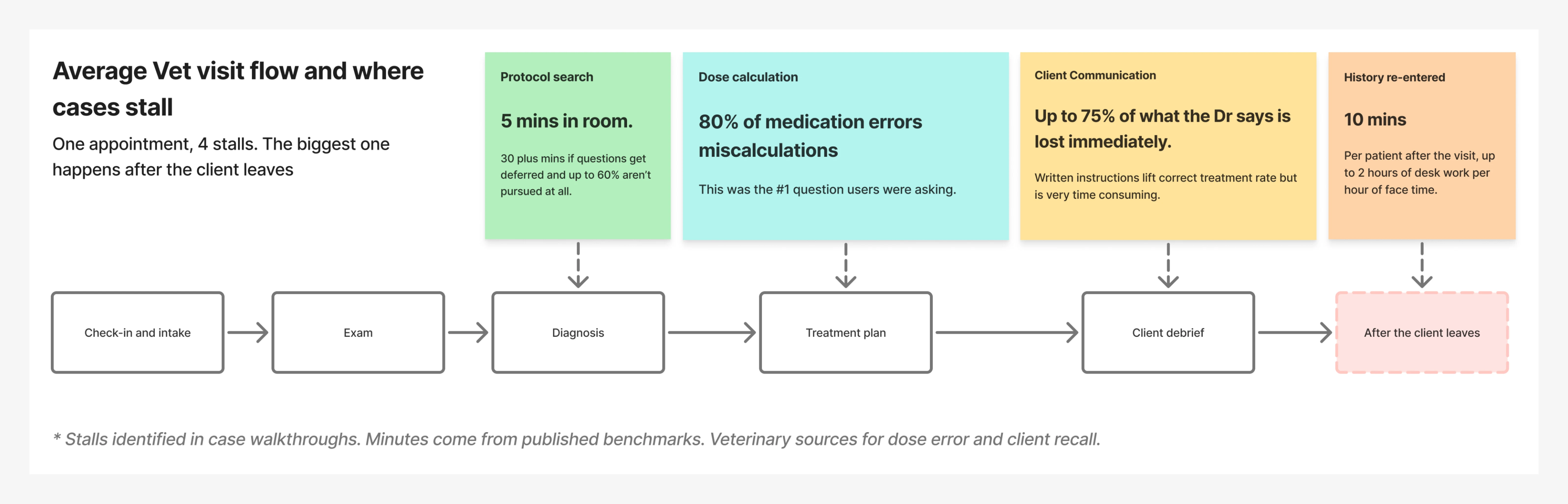
Average vet visit flow and where cases stall: one appointment, 4 stalls, the biggest after the client leaves. Six phases run left to right: check-in and intake, exam, diagnosis, treatment plan, client debrief, and after the client leaves. Four stall cards hang above the phases they interrupt: protocol search, 5 minutes in room, 30-plus if questions get deferred, and up to 60 percent never pursued; dose calculation, cited in 80 percent of medication errors as miscalculations and the number-one question users asked; client communication, up to 75 percent of what the doctor says lost immediately, with written instructions lifting the correct-treatment rate but costing time; and history re-entered, 10 minutes per patient after the visit, up to 2 hours of desk work per hour of face time. A footnote reads: stalls identified in case walkthroughs, minutes from published benchmarks, veterinary sources for dose error and client recall.

We designed the whole records system. We could build one piece of it.

The first plan was a full EHR replacement: patient workspace, medical history, medications, and an assistant, all mocked up on the design system I had built for the product.

The team was part-time, ten hours a week at most, and the dev team could not take on a build that size.

I recommended to the founder that we cut to the one piece that did not need a records migration to be useful: the assistant. It ran on the same design system, and we kept the patterns simple enough for the team to maintain at that capacity.
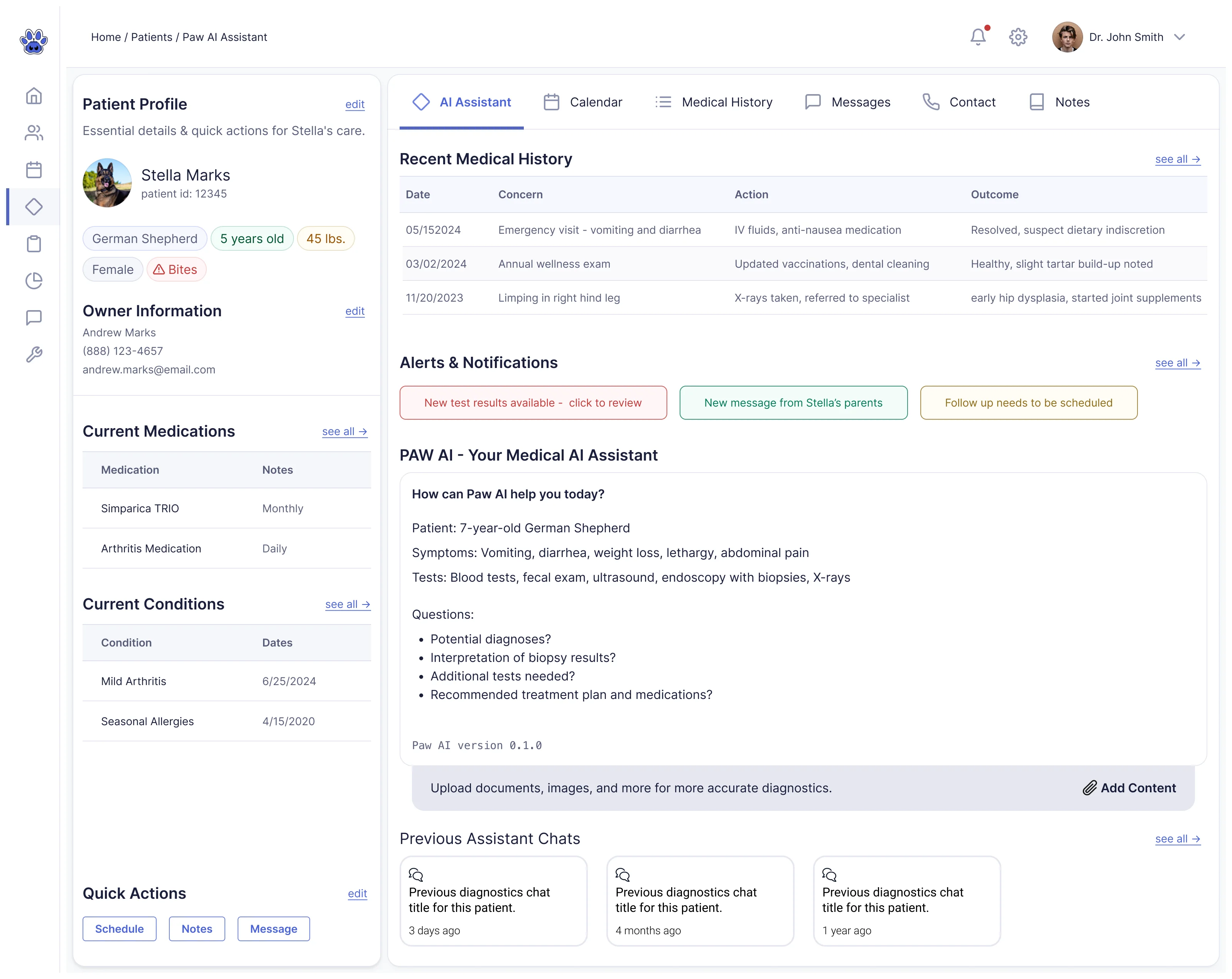
Paw AI EHR design: a patient dashboard for a German Shepherd with profile, medications, conditions, recent medical history and alerts, and the Paw AI assistant in the main panel composing a case question (signalment, symptoms, tests run, and the questions to ask) above a row of previous assistant chats.
The full EHR from discovery: patient profile and medications down the left, history and alerts across the top, and the assistant holding the main panel.
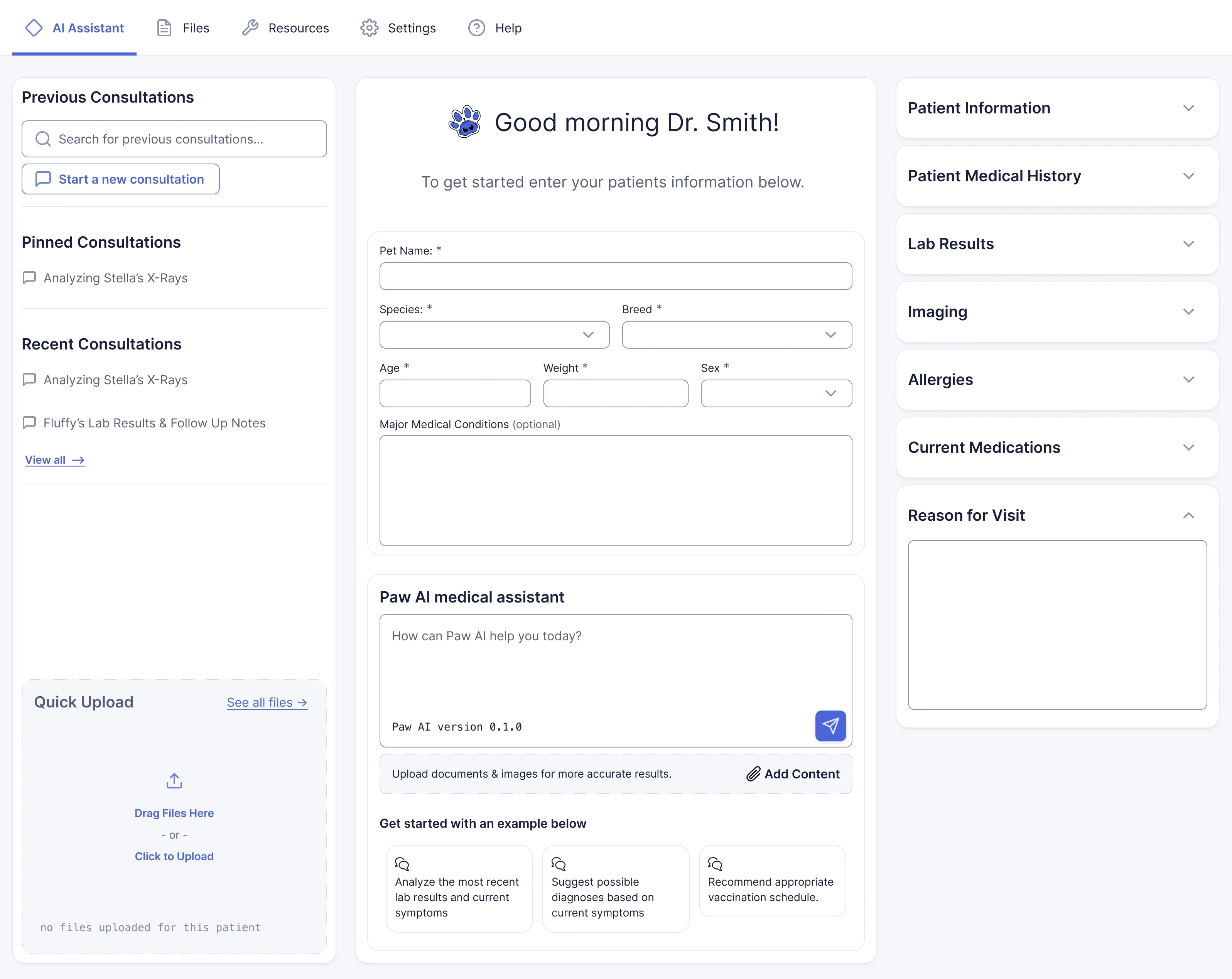
Chat-focused Paw AI design: a new-consultation view centered on the medical assistant chat, with patient information, lab results, and imaging collapsed into side panels.
The view built for use during an appointment, pulling past notes, lab results and uploads into the conversation. This is the slice that became the product.

The pilot set the roadmap: dose calculator, discharge generator, lab interpreter.

We ran ChatVET in one working clinic and expanded to three. We logged what vets asked for.

Three tools came back in demand: a medication dose calculator, a discharge generator, and a lab interpreter. Dosing was the most-asked question by a wide margin.

All three open from a new chat or from the middle of one, so the case already on screen carries into them.

Answers are restricted to the Merck Veterinary Manual and leading journals.
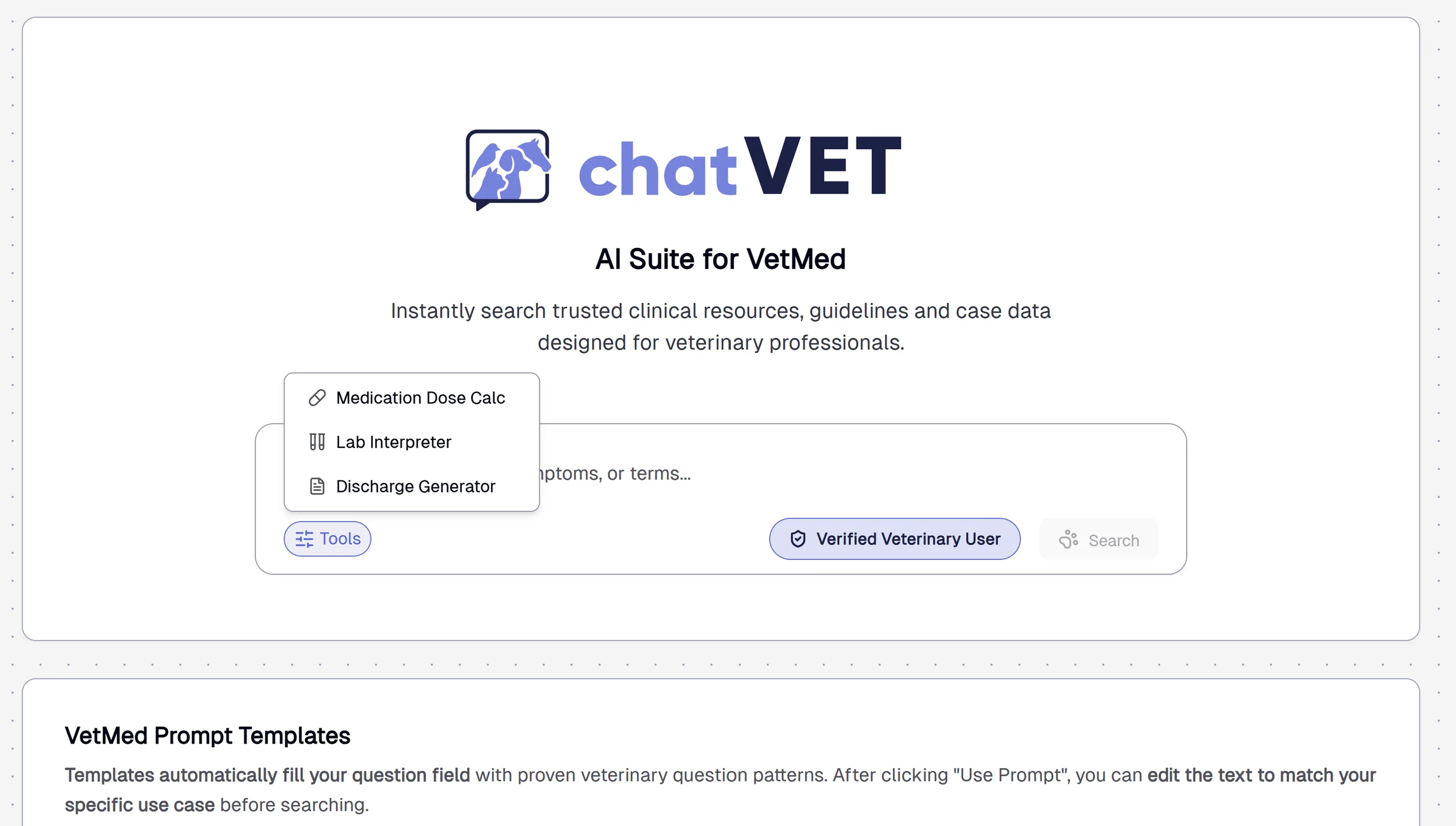
The ChatVET home for a verified veterinary user with the Tools menu open, listing Medication Dose Calc, Lab Interpreter, and Discharge Generator above the VetMed Prompt Templates panel.
Dose calculator, lab interpreter and discharge generator, opened from the chat so nothing has to be re-typed.
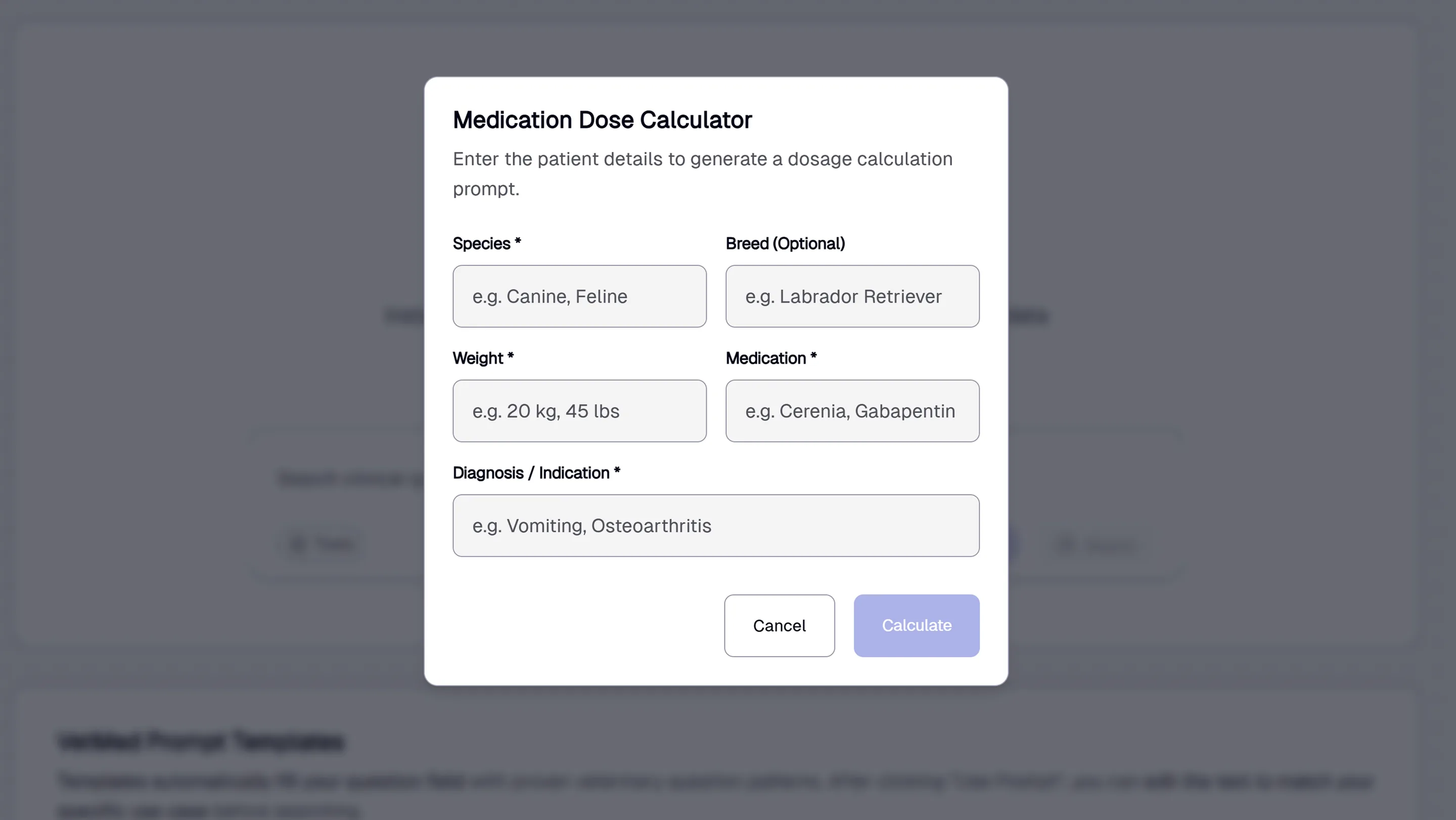
The Medication Dose Calculator dialog with fields for species, breed, weight, medication, and diagnosis or indication, and a Calculate button.
Species and weight first (the intake number the calculation depends on), then medication and indication.
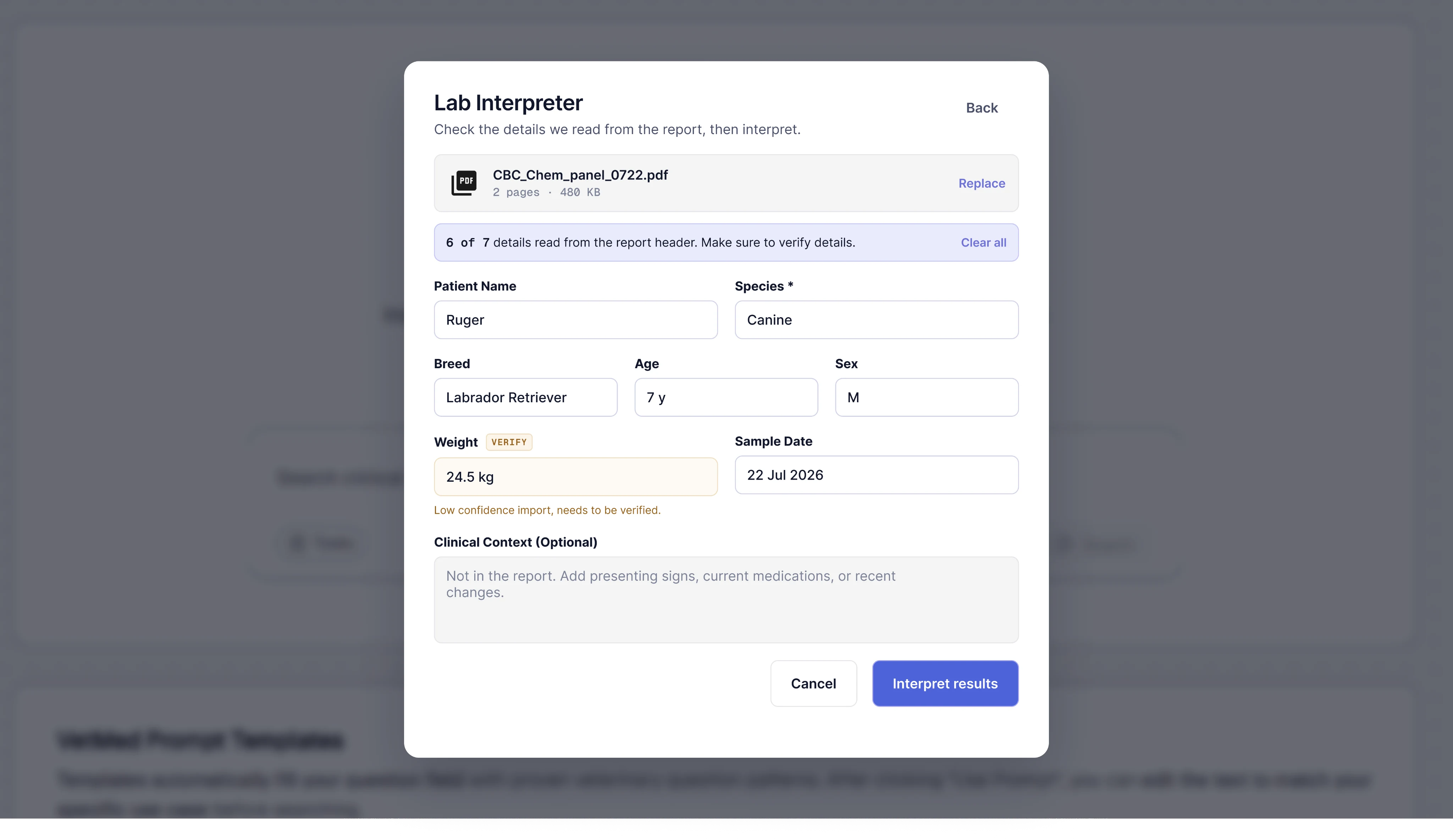
The Lab Interpreter dialog after uploading a two-page CBC and chemistry panel PDF: six of seven details read from the report header with a prompt to verify them; patient fields filled for Ruger, a seven-year-old male Labrador Retriever; the weight field, 24.5 kilograms, carries a VERIFY tag reading low confidence import, needs to be verified; an optional clinical-context box sits above Cancel and Interpret results buttons.
It reads the report before it interprets: patient details extracted from the PDF, and the one low-confidence value (weight, the dosing input) flagged for a human to verify first.
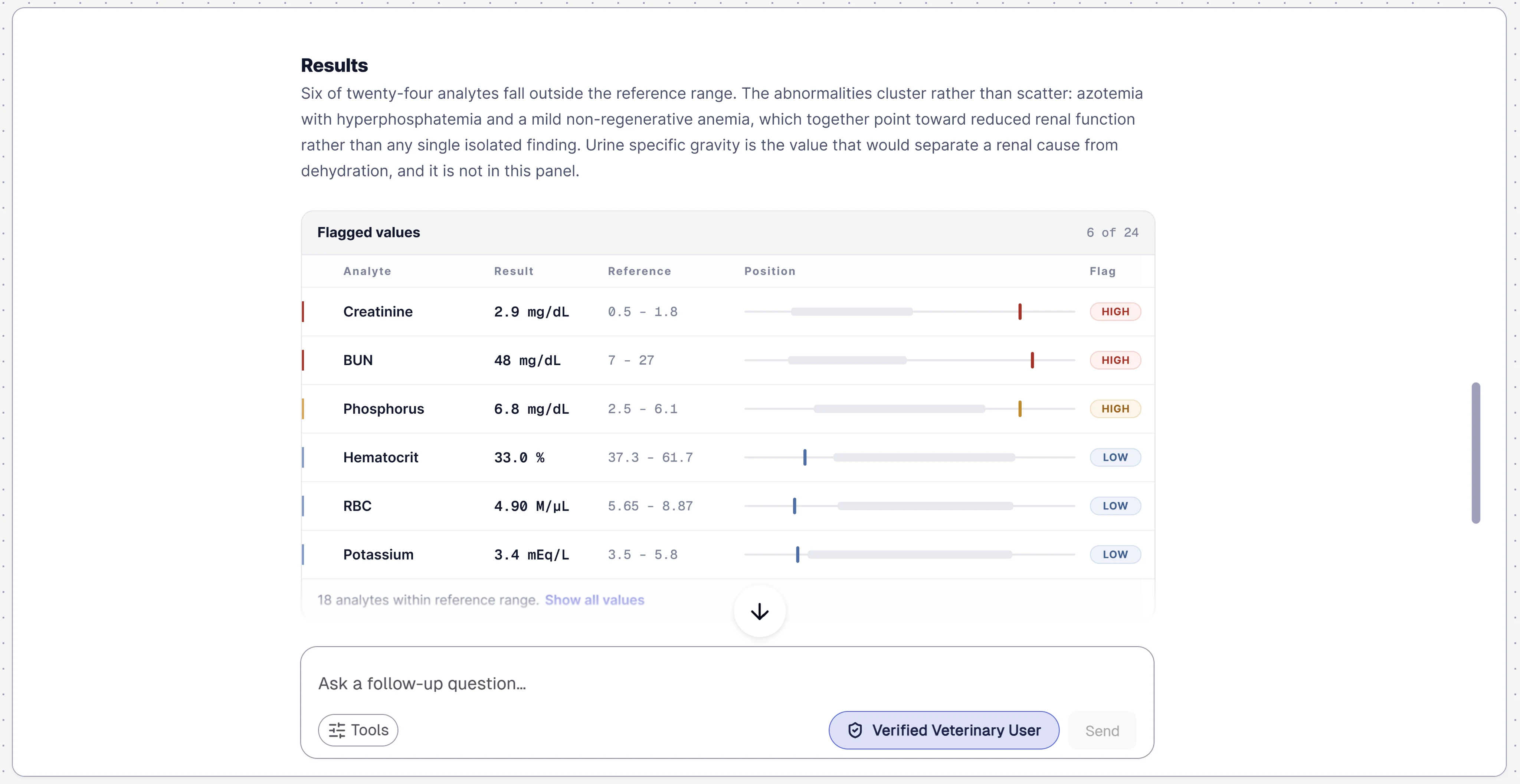
Lab Interpreter results: a narrative read stating six of twenty-four analytes fall outside reference range and cluster rather than scatter (azotemia with hyperphosphatemia and a mild non-regenerative anemia pointing toward reduced renal function), noting that urine specific gravity would separate a renal cause from dehydration and is not in this panel. Below, a flagged-values table shows creatinine, BUN and phosphorus high and hematocrit, RBC and potassium low, each with a reference-range position bar, above a follow-up composer carrying a Verified Veterinary User badge.
Six of twenty-four analytes flagged and read as a cluster instead of a list. It also names the one value that would settle the differential as missing from the panel.
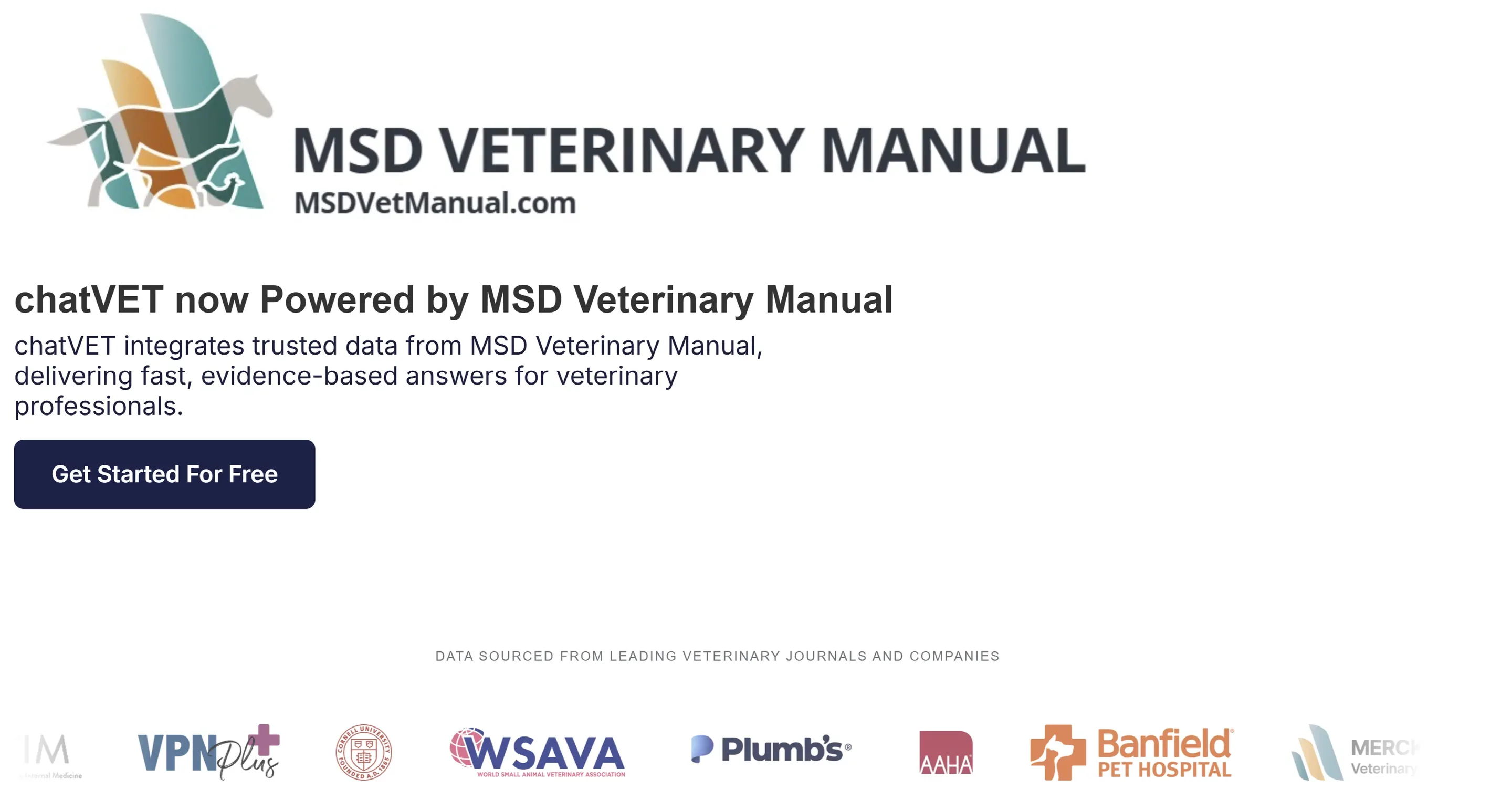
ChatVET announcement banner reading 'chatVET now Powered by MSD Veterinary Manual', above a sourcing strip captioned 'data sourced from leading veterinary journals and companies' with logos for the Journal of Veterinary Internal Medicine, VPN Plus, Cornell University, WSAVA, Plumb's, AAHA, Banfield Pet Hospital and the Merck Veterinary Manual (the first and last clipped at the edges of the capture).
Partnership announcement taken from the chatvet.ai website
“ChatVET gives us instant answers. It helps us find the right veterinary data in seconds, eliminating time-consuming research. Unlike ChatGPT or Copilot, it’s actually built for the way vets think.”
// DVM PILOT USER IN VETERINARY CLINIC

A template library replaced prompt-writing with a few fields.

In the pilot, vets wrote prompts that returned inconsistent results, and the same clinical question came back differently depending on how it was asked.

I designed a template library organized by clinical job: SOAP notes, discharge instructions, differentials, and client emails. Vets replace the highlighted details and press enter.

Consistency mattered as much as the time saved. The same question returns the same shape of answer regardless of who asks it.
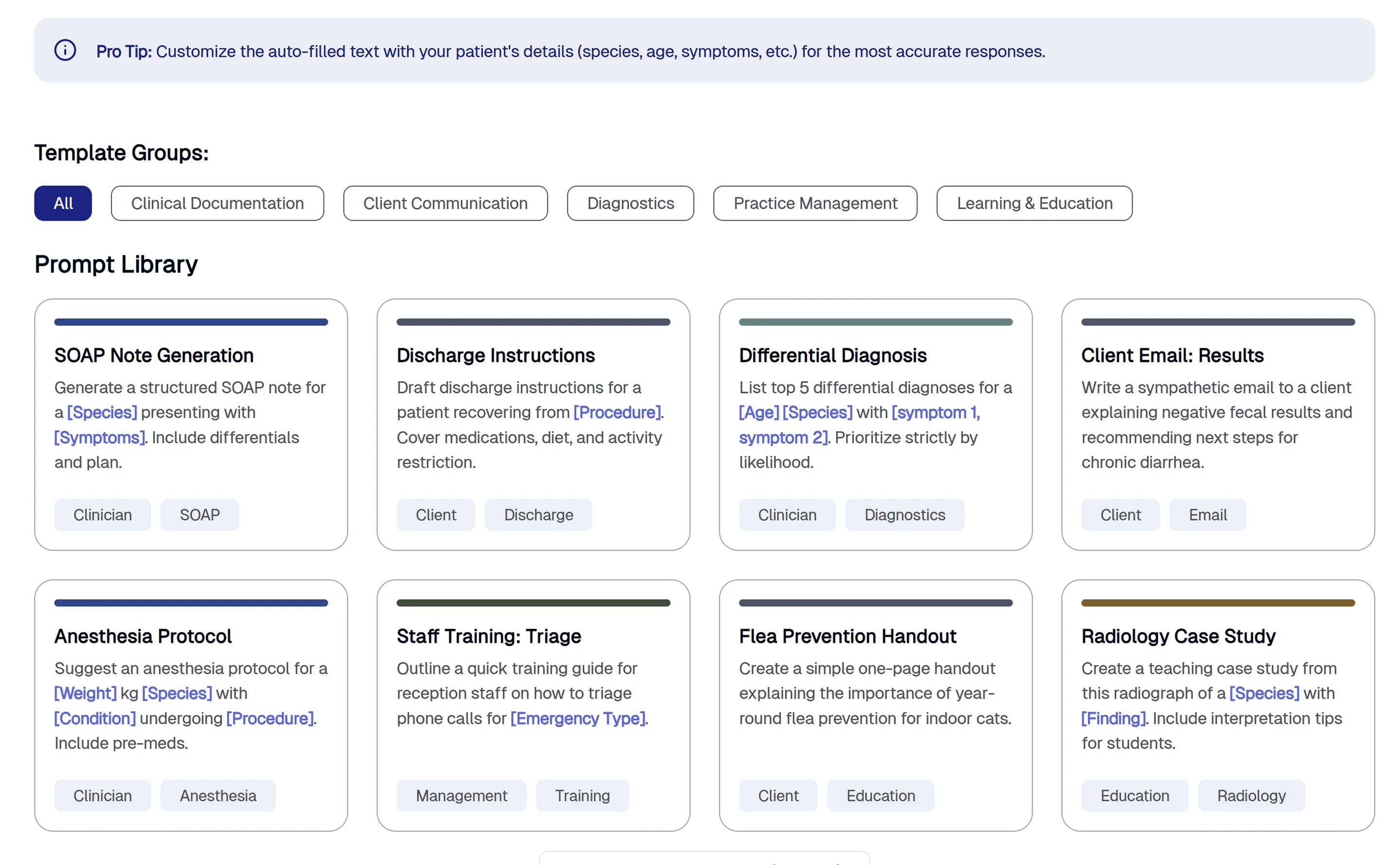
The VetMed prompt library: template group filters for clinical documentation, client communication, diagnostics, practice management, and learning, above eight template cards including SOAP Note Generation, Discharge Instructions, Differential Diagnosis, and Client Email Results, each tagged Clinician or Client.
Templates built from the questions vets were already asking, grouped by clinical job and tagged for their reader: clinician or client.

The discharge generator writes the client handout from the consultation that already happened.

I designed the print output and reworked the discharge generator around the chat context.

It reads the consultation back, asks which of the medications discussed should go home with the client, and fills the handout from there. The owner leaves with instructions they can follow, and nobody stays late writing them.
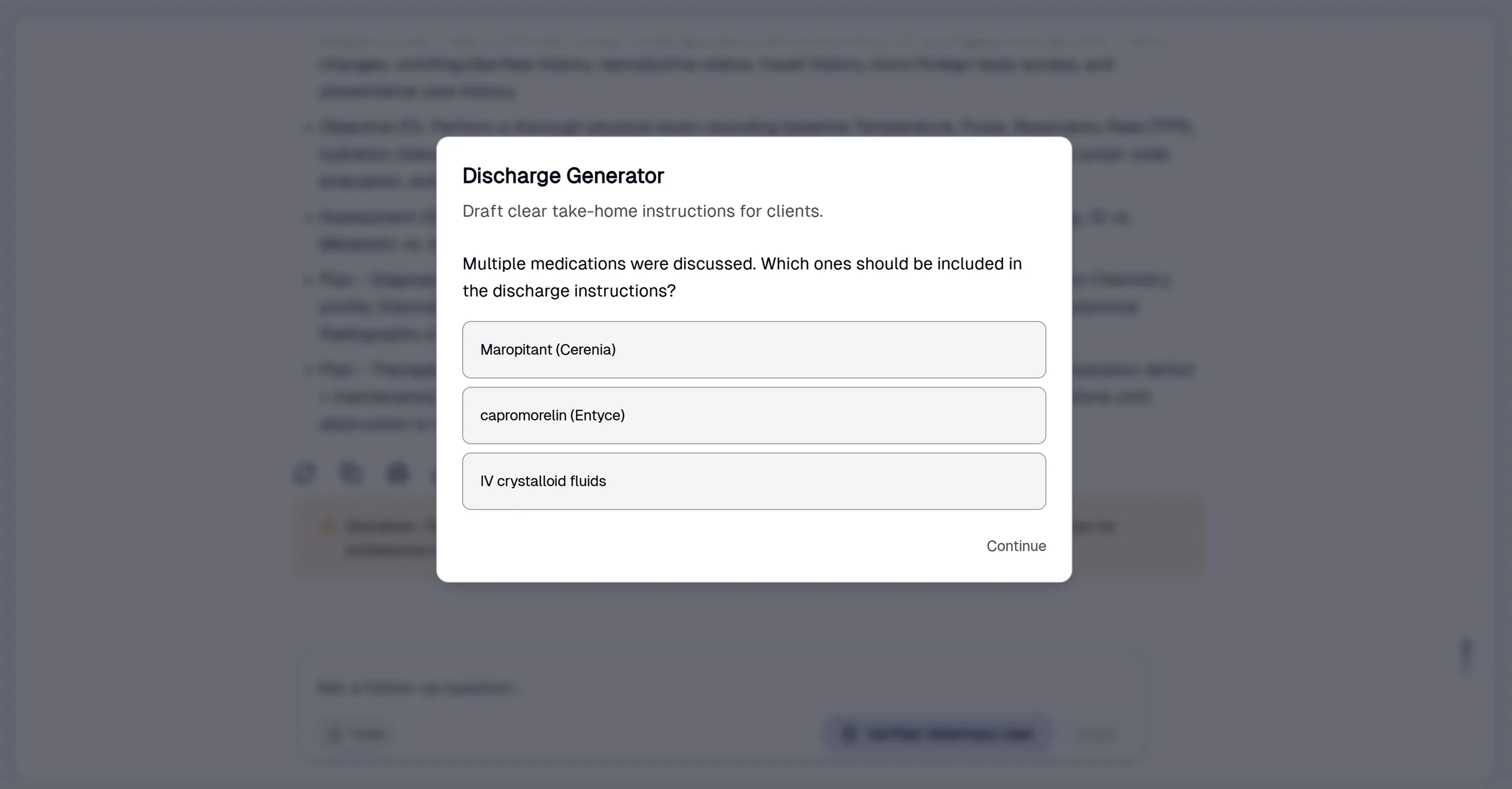
The Discharge Generator dialog asking which of the medications discussed should be included in the discharge instructions, listing maropitant, capromorelin, and IV crystalloid fluids.
It reads the consultation back: several medications came up. Which should go home with the client?
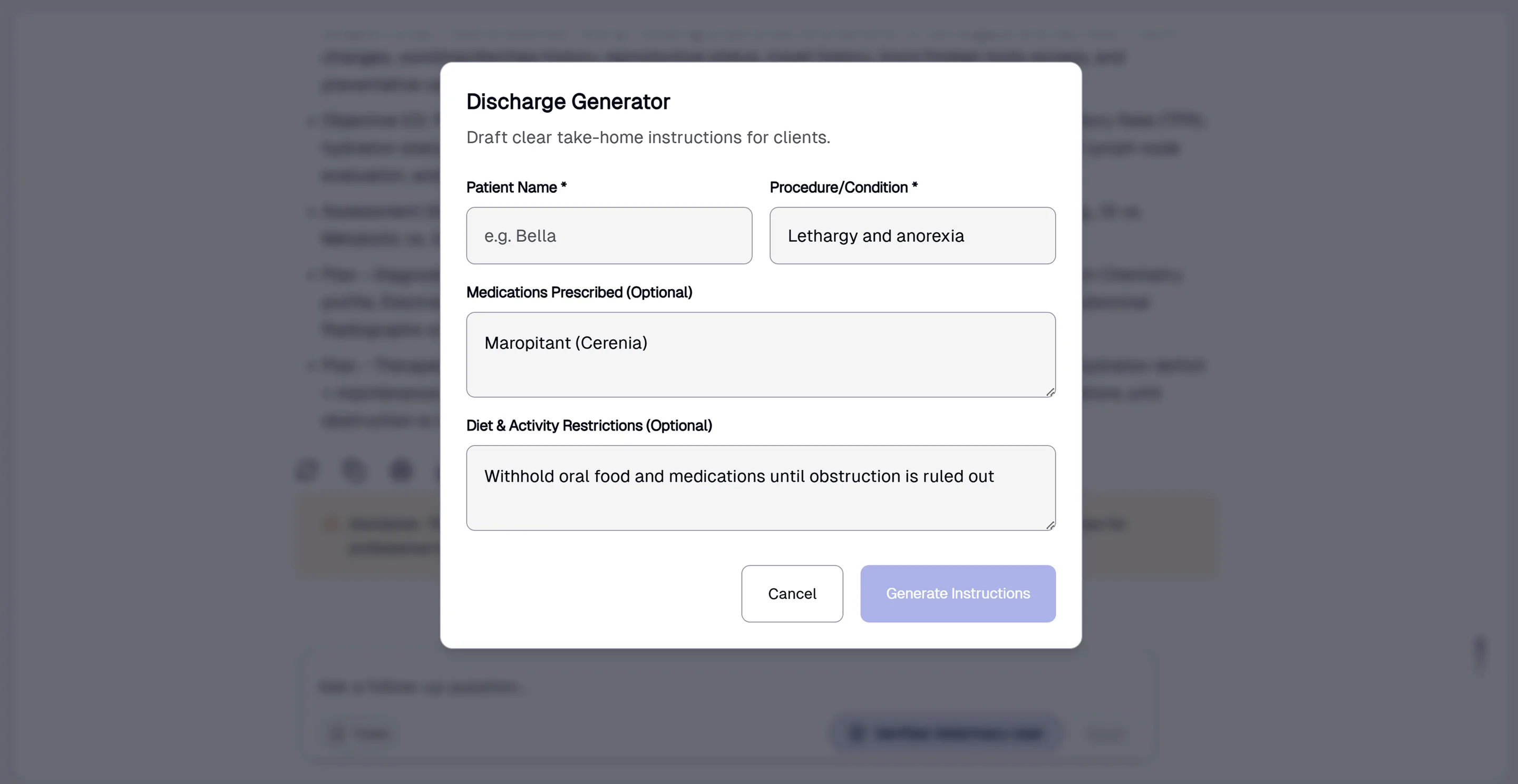
The Discharge Generator second step with fields for patient name, procedure or condition, medications prescribed, and diet and activity restrictions, above a Generate Instructions button.
Patient, condition, medications and the restrictions an owner has to follow, most of it already filled from the chat.
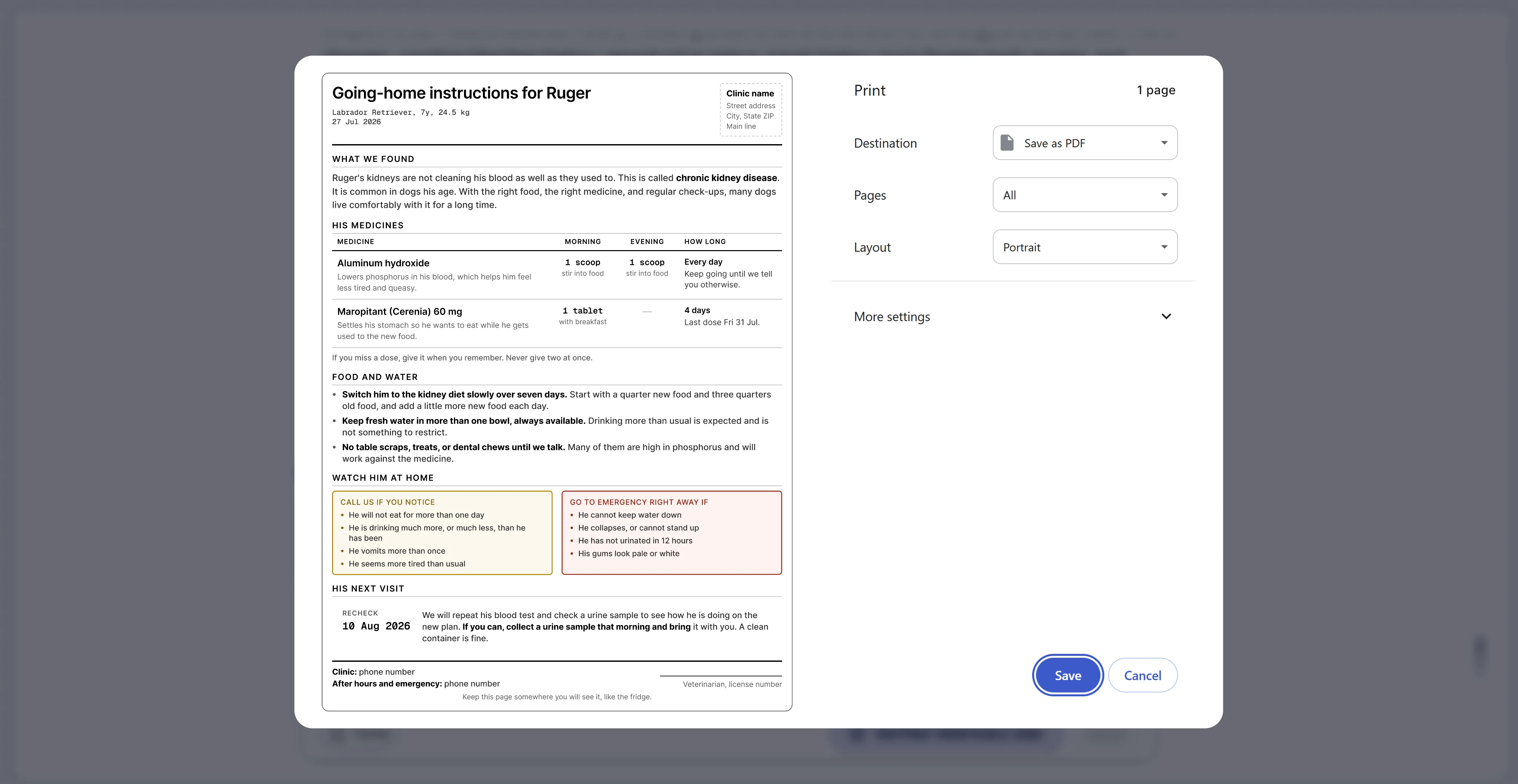
A print dialog showing Going-home instructions for Ruger, a seven-year-old Labrador Retriever, one page, saving as PDF. What we found explains chronic kidney disease in plain language; a medicines table lists aluminum hydroxide and maropitant with morning, evening and how-long columns; food-and-water rules cover a gradual kidney-diet switch; watch-him-at-home boxes split call-us-if-you-notice from go-to-emergency-right-away; and a recheck on 10 Aug 2026 sits above clinic and after-hours numbers, a veterinarian signature line, and a note to keep the page somewhere visible, like the fridge.
The payoff, printed: what we found in plain language, morning-and-evening doses, call-us versus go-to-emergency lists, and the recheck date. Generated from the same case as the labs above, ready before the client reaches the door.

500 vets logged in last month, with no sales effort behind it.

The web app is live. 500 registered users signed in over the past month, worldwide, and clinics are piloting the business tier ahead of a paid rollout. Growth has been bottom-up.

Vets in the pilot reported saving about 15 minutes per case. That was never instrumented, so it is what they told us and nothing more.

The screens in this study are the version I designed and shipped. My role shifted in June from design to investor and marketing material, and the product has kept changing since.

If I ran this again, I would instrument the discharge flow before shipping it. We never set up a way to find out whether those handouts changed anything after the client left.
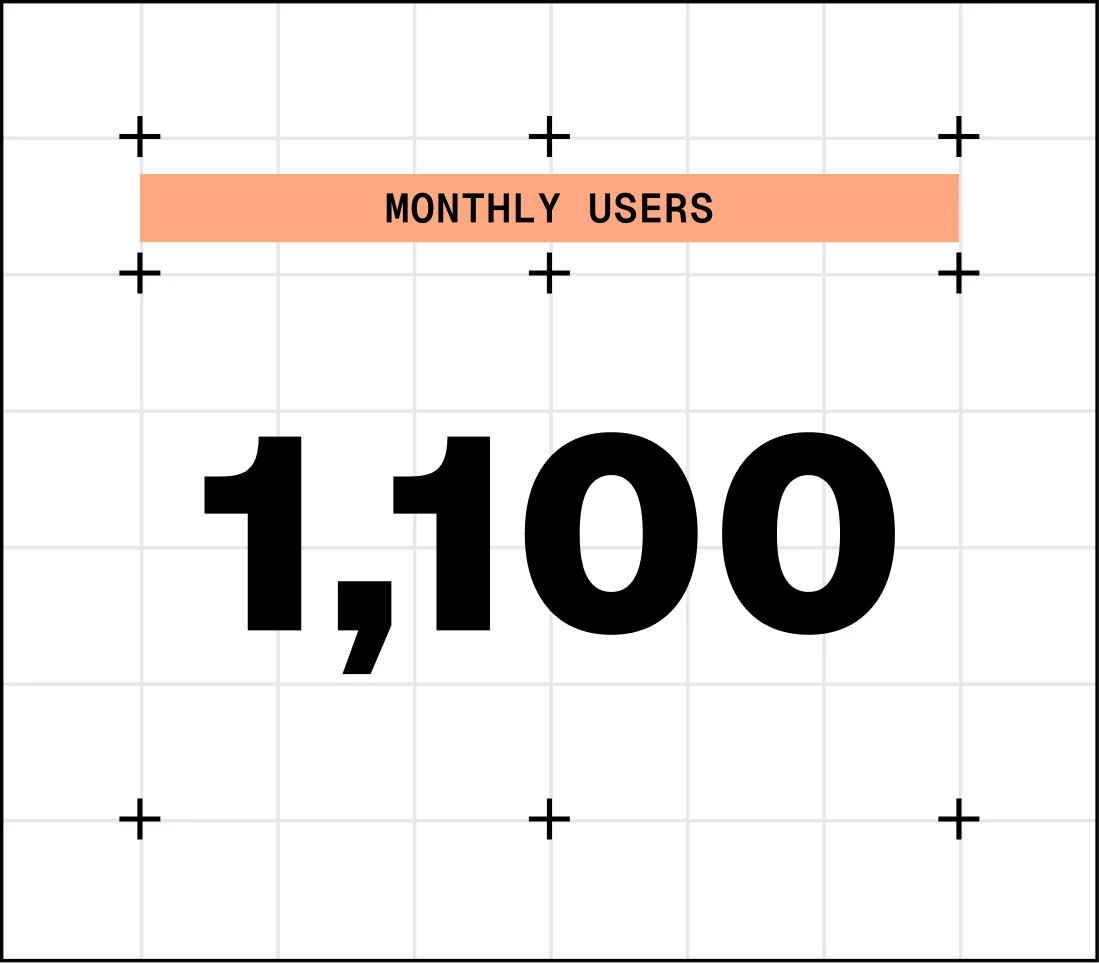
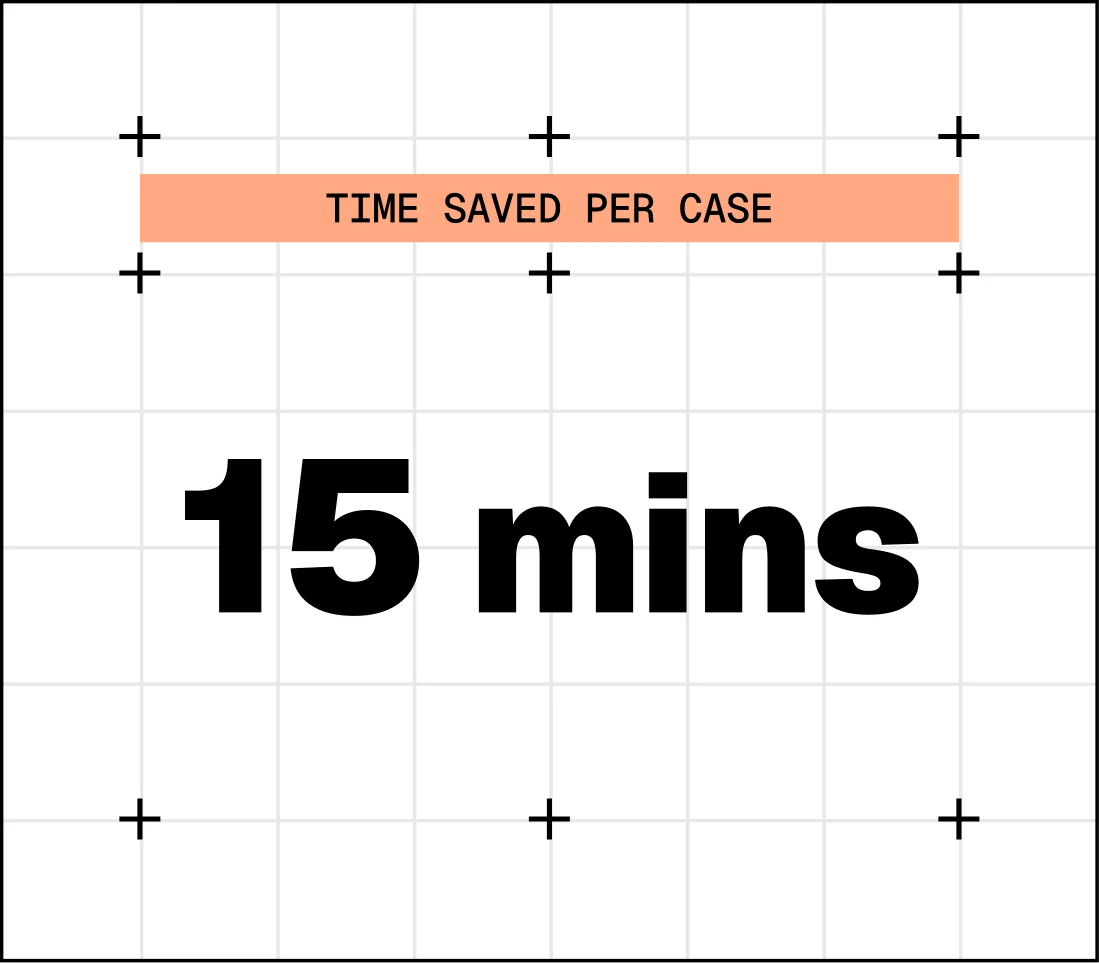
Stat card: monthly users, 500.Stat card: time saved per case, 15 minutes.

// ACTIVE USERS CURRENTLY ON THE PLATFORM, TIME SAVED SELF-REPORTED FROM PILOT USERS.

UP NEXT:

AI Powered Personal Knowledge OS

A multi-agent system that reads thousands of sources, building a living corpus.

Knowledge OS dashboard listing captured links with sources, categories, scores, and agent navigation
01 resume (PDF, opens in new tab)

Product Designer engineering intuitive UX for complex DoD, GovTech, and AI systems.

02 X.com (opens in new tab)

Follow @andrewmarksart for design, vibe coding, the latest AI news, and things I think are cool or interesting.

03 Linked in (opens in new tab)

Connect with me on LinkedIn /in/andrewmarksart/ as I build projects in public on AI agents & the future of UX.

04 GitHub (opens in new tab)

View my public work on GitHub. DM for access to select private AI and UX repositories.

05 About

Focused on how humans and AI work together. From secure DoD systems to rapid AI prototyping, I use my background to turn complex data into UX research and design that lets AI systems scale.

Reach me directly: